
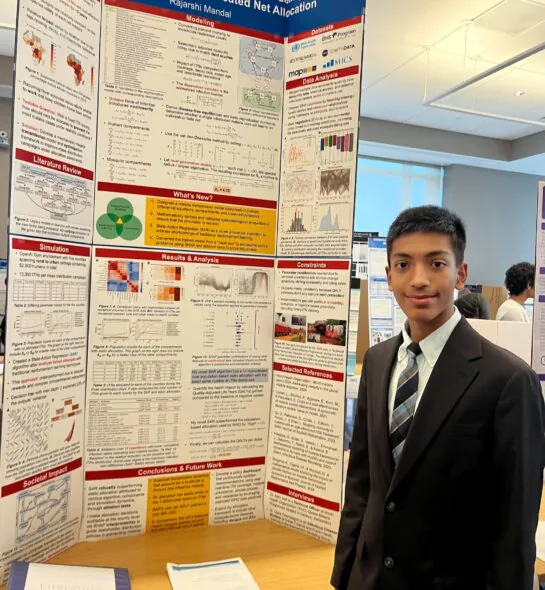

Rajarshi Mandal

Rajarshi Mandal

2026 Davidson Fellow
$50,000 Scholarship

Age: 16
Hometown: Lexington, MA

Science: "Ordinary Differential Equation Modeling of Malaria Transmission Dynamics for Optimized ITN Allocation Strategies"

About Rajarshi

Hello! I’m Rajarshi, a rising junior at Lexington High School in Massachusetts. I love working on computational problems in health and biology, from brain signals to mosquito populations. I have pursued advanced mathematics and computing beyond my high school curriculum and plan to study mathematics and computer science in college.

Outside of academics, I play piano, which has taken me twice to Carnegie Hall, and am currently learning Liszt’s “La Campanella.” I’m also teaching myself to beatbox, with mixed results so far. I enjoy lifting, playing volleyball, skiing and mountain biking and hold a black belt in karate.

Skip testimonial carousel

"I am honored to be named a Davidson Fellow. Joining a community of ambitious young researchers means a lot, and it encourages me to keep working on problems where better decisions save lives."

Project Description

Insecticide-treated nets are the cheapest way to prevent malaria, but there are never enough of them, so organizations handing them out mostly split their supply by population. This does not account for some mosquitoes becoming resistant to the insecticide, transmission spiking with climate fluctuations and nets degrading over time.

I made a simulation of how malaria actually spreads under these realistic conditions and used it to evaluate where each net has the largest effect. With the same number of nets, my approach prevented twice as many infections. About 200 million nets are distributed every year, so even small improvements in where they go can prevent a lot of illness.

Deeper Dive

I started this project after watching New York Times footage of fishermen weaving donated nets into dragnets because they were the only fish mesh available. Roughly 200 million insecticide-treated nets are distributed each year, mostly based on population. This approach ignores insecticide resistance, seasonal surges in transmission and net decay. That is why I developed a malaria transmission simulation that accounts for all three and used it to create allocation policies for a fixed supply. With the same number of nets, my allocator prevented twice as many cases as current practice. Nets are already a cost-effective malaria intervention, so optimizing their distribution could save more lives without increasing the budget.

I began with a Deep Q Network, but each allocation’s outcomes were affected by noise and delayed rewards, preventing the value estimates from converging. I eventually replaced it with a new architecture that scored candidate allocations directly to avoid the instability. Earlier, malaria prevalence in my simulation kept falling to zero, which did not reflect endemic regions. Dr. Clara Champagne from the Swiss Tropical and Public Health Institute suggested I investigate backward bifurcation. I derived the transmission model’s reproduction number and confirmed the simulation could sustain transmission at realistic biting rates. Through the Non Trivial Research Scholars Program, I also learned to evaluate my own impact claims and better understand operational realities from people working in the field.

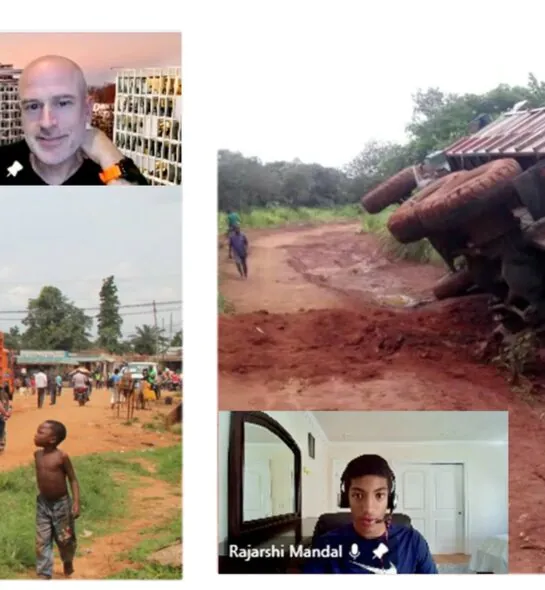
What surprised me most about malaria is how rarely it is fatal. The mortality rate is around 0.2%, meaning most infections instead lead to weeks of fever and anemia. Farmers may miss planting season, shopkeepers may have to close their stores and students may miss school or stay home to care for a sick sibling. Every net that reaches a high-transmission area can help prevent some of that. My framework projects where cases could spike and accounts for tradeoffs involving insecticide resistance, seasonality and remoteness. Dr. Seth Irish, a technical officer at the WHO Global Malaria Programme, showed me a picture he took of a transport truck overturned on a road in the Democratic Republic of Congo, its nets spilled. It is impossible to account for every operational disruption, but I can help maximize the impact of the nets that do arrive.

Q&A

If you could have dinner with the five most interesting people in the world, living or dead, who would they be?

John Conway, Sergei Rachmaninoff, Wing, Noah Lyles, and Ronald Ross. Conway invented the Game of Life and surreal numbers, and I love how he made math so much fun. Rachmaninoff had massive hands and wrote thrilling preludes. Wing is one of the most creative beatboxers alive and a big reason I started. Noah Lyles because I used to sprint, and I have watched a lot of his technique videos and want to ask him about them in person. Ronald Ross proved in 1897 that mosquitoes carry malaria, so he would probably have some thoughts about my project!

What are the top three foreign countries you’d like to visit?

Norway, Spain, and South Korea. Norway has beautiful fjords and some of the best skiing in the world. Spain has an amazing cultural heritage and I could finally practice my Spanish with native speakers. South Korea has incredible food and a culture I have been curious about for a long time.

What is your favorite hobby?

I enjoy skiing during the winter, especially right after a big snowstorm when there is fresh powder.

Skip carousel

Click image to download high resolution files

In The News

Rajarshi Mandal, 16, of Lexington, has been awarded a $50,000 Davidson Fellows Scholarship for the science project, Ordinary Differential Equation Modeling of Malaria Transmission Dynamics for Optimized ITN Allocation Strategies. The Davidson Fellows Scholarship is one of the nation’s most prestigious honors for students 18 and younger.

Download the full press release here