

Deeper Dive
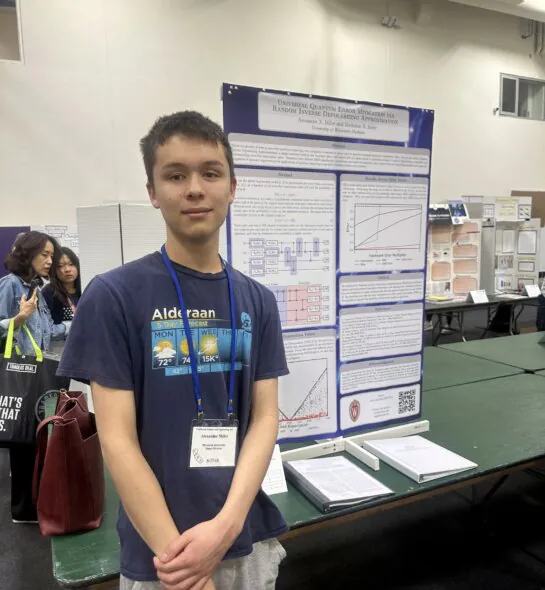
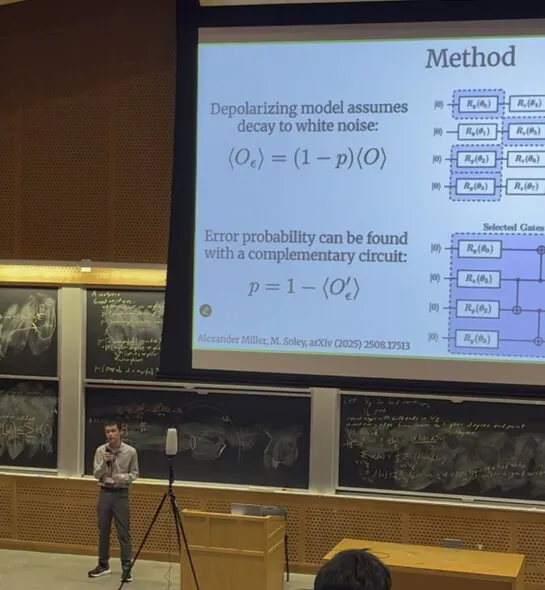
Quantum computers can perform many tasks that are impossible for classical computers because the required computational power scales exponentially, such as simulating complex chemical systems for drug design and materials science. My first experience with quantum computing research was during my sophomore year of high school as a member of the Soley Research Group at UW Madison, where I worked on improving an algorithm that enables quantum computers to simulate different kinds of chemical states. From this project and my other experiences in quantum computing, it became evident that the exciting capabilities we were researching were limited by the high error rates of present-day hardware. As the largest obstacle to practical quantum computing, the problem of error is being attacked on all fronts by researchers around the world. Some researchers work on improving the hardware, while others work on algorithmic ways to correct errors as they occur. I decided to work on a subset of methods called error mitigation, where I developed a method to estimate error-free results of computations based on their error-ridden counterparts. I hope my research can join the range of methods that can be applied, often in tandem, to bring practical quantum computing one step closer.
The greatest challenge I faced during my research was coming up with a viable idea that had not already been discovered or surpassed by existing error mitigation research. I spent six months during my junior year of high school in a cycle of creating ideas, testing them, not getting successful results and then using the parts that worked to inspire my next idea. I worked closely with Dr. Soley during this time, who was especially helpful in providing another perspective on how to compare my work with existing methods and helping me find these methods in the literature. After I finally created an idea that worked, I continued working with Dr. Soley to get feedback on my tests, mathematical derivations and rough drafts of my paper.
I hope my project will help make a variety of quantum algorithms more practical to run in the real world. Most immediately, these applications would include accelerating the development of new drugs and materials by allowing quantum computers to more accurately simulate the underlying physics. Running large-scale quantum physics simulations on classical computers is intractable to the point of being impossible in many cases, and quantum computers promise to run some of these simulations in a fundamentally different and exponentially more efficient manner.