

Audrey Zheng

Audrey Zheng

2026 Davidson Fellow
$50,000 Scholarship

Age: 17
Hometown: Wexford, PA

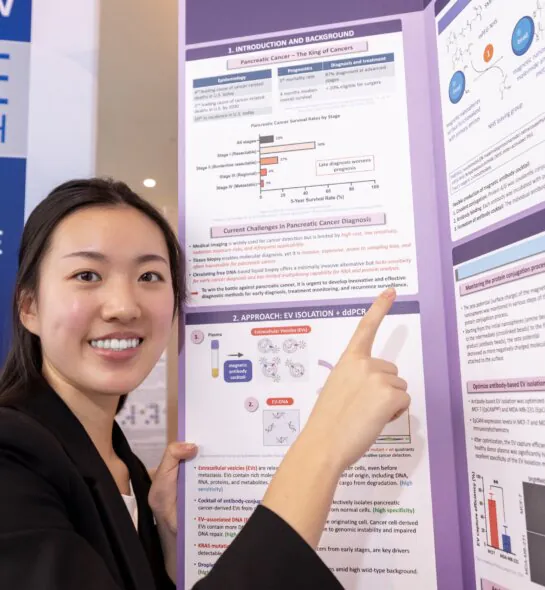
Science: "Targeted Isolation of Tumor-Derived Extracellular Vesicles Using a Cocktail of Magnetic Nanospheres for Minimally Invasive Pancreatic Cancer Diagnosis"

About Audrey

Hello! I’m Audrey Zheng, a rising freshman at Stanford University from Pittsburgh, Pennsylvania. I’m interested in health care and engineering and look forward to exploring different disciplines before deciding on a major.

Outside of research, I love food and cooking and enjoy experimenting with new recipes. I also founded The Food Lounge Pittsburgh, a student-led organization that brings young people together to support local food distributions, soup kitchens and senior communities. Through this work, I’ve learned how small efforts can make a difference when people work together.

Throughout high school, I also played varsity tennis, participated in robotics and trained in traditional Chinese dance. Looking ahead, I hope to bring together my interests in science, health care, engineering and service to address problems that matter to people.

Skip testimonial carousel

"Being named a Davidson Fellow is an incredible honor. I’m immensely grateful for this opportunity and excited to join such a passionate community of young innovators who share that same curiosity and drive. This recognition inspires me to continue taking on challenging problems that can improve people’s lives."

Project Description

My project developed a blood test for detecting pancreatic cancer, a disease that is often diagnosed too late because there are few symptoms in its early stages. My method uses a cocktail of tiny magnetic particles to capture microscopic packages called extracellular vesicles that are released by cancer cells into the bloodstream. I then analyzed the DNA content of these packages for genetic changes associated with pancreatic cancer. Because the test only requires a blood sample, this approach could provide a minimally invasive way to detect pancreatic cancer earlier, when treatment is more likely to be successful.

Deeper Dive

In my project, I developed a blood-based method for detecting pancreatic cancer. Pancreatic cancer is one of the few major cancers whose mortality rate has not declined substantially over the past few decades. One reason is that pancreatic cancer is often asymptomatic in its early stages, meaning many patients are not diagnosed until the disease has progressed. Survival rates can fall from over 80% in early-stage disease to around 3% in advanced stages. I wanted to address this challenge by developing a more accessible and minimally invasive approach to early detection.

Cancer cells release tiny packets of biological information, called extracellular vesicles (EVs), into the bloodstream. However, cancer-derived EVs make up only a tiny fraction of all EVs circulating in the blood, making them difficult to detect. To overcome this, I developed a cocktail of magnetic nanospheres equipped with three different cancer-recognizing antibodies to selectively capture pancreatic cancer-associated EVs. I then analyzed their DNA for KRAS mutations, which are found in the vast majority of pancreatic cancers. By enriching these EVs before mutation detection, my approach could help improve the sensitivity and specificity of blood-based pancreatic cancer detection and ultimately contribute to earlier diagnosis.

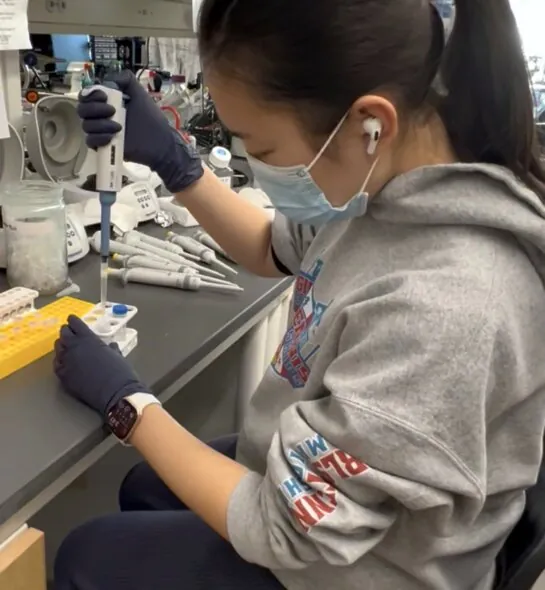
Many of my experiments required long, uninterrupted hours in the lab over consecutive days, which was especially challenging during the school year. Experiments often failed or produced unexpected results, and setbacks were discouraging after investing so much time and effort. Nonetheless, I often learned the most by working through that uncertainty and frustration. Research taught me to be patient, persistent and willing to rethink my approach when things did not go as planned.

Ultimately, I hope this work can contribute to earlier and more accessible pancreatic cancer detection. Because my method requires only a blood sample, it could offer a minimally invasive approach that complements existing diagnostic methods. Earlier detection could give patients more treatment options and, most importantly, more time. The underlying strategy could also potentially be adapted to other diseases by changing the antibodies on the magnetic nanospheres to target different disease-specific markers. While my research is only one step toward that goal, I hope continued development and validation of blood-based detection methods can help improve outcomes for patients facing this devastating disease.

Q&A

What is your favorite tradition or holiday?

My favorite holiday is Dragon Boat Festival. I love making zongzi with my mom.

What is one of your favorite quotes?

“Do not go where the path may lead, go instead where there is no path and leave a trail.” — Emerson

If you could have dinner with the five most interesting people in the world, living or dead, who would they be?

Rosalind Franklin, Zhuge Liang, Robert Weinberg, Emma Watson, Richard Feynman

Skip carousel

Click image to download high resolution files

In The News

Audrey Zheng, 17, of Wexford, has been awarded a $50,000 Davidson Fellows Scholarship for the science project, Targeted Isolation of Tumor-Derived Extracellular Vesicles Using a Cocktail of Magnetic Nanospheres for Minimally Invasive Pancreatic Cancer Diagnosis. The Davidson Fellows Scholarship is one of the nation’s most prestigious honors for students 18 and younger.

Download the full press release here