


Bryan Zhu

Bryan Zhu

2026 Davidson Fellow
$25,000 Scholarship

Age: 18
Hometown: Bellevue, WA

Mathematics: "Dimension Reduction for Convex Optimization via Color Refinement"

About Bryan

I’m Bryan, a rising freshman at MIT. Outside of school, I took several math classes through Art of Problem Solving, most notably Olympiad Geometry and Group Theory. At MIT, I intend to double major in mathematics and computer science.

For my career, I am interested in pursuing quantitative finance or frontier AI. In my free time, I enjoy trying new food and milk tea, playing with my two Pomeranians, Pom and Snow, and listening to big band jazz.

Skip testimonial carousel

"I’m honored to be named a 2026 Davidson Fellow for my work. This recognition means a lot to me because it celebrates both the mathematical results and the broader potential I see in my work."

Project Description

Optimization, mathematically finding the best possible value of an expression subject to certain conditions, has a large variety of applications. But computation time and memory requirements grow rapidly with variables and constraints, so reducing the size of optimization problems before solving them is critical. One way to make optimization more efficient is to identify parts of the problem that behave similarly and merge them.

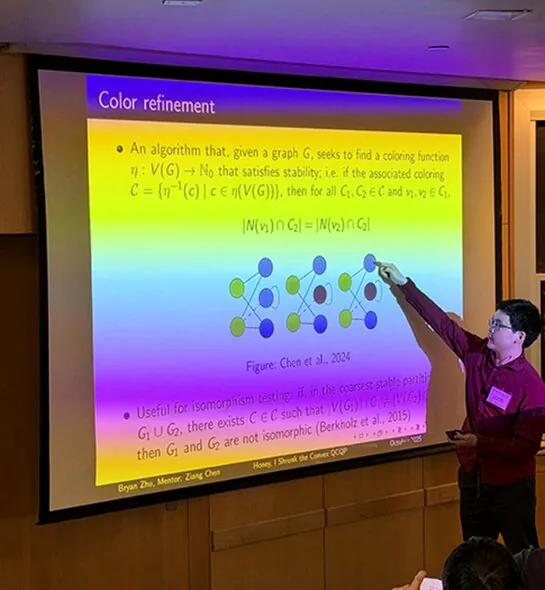
I built on color refinement, an algorithm that can group equivalent variables or constraints in an optimization problem. Prior work applied color refinement to relatively simple cases, specifically linear programs and convex linearly constrained quadratic programs (degree 1 or 2). I generalized this idea to arbitrary convex optimization and mathematically proved that my method guarantees identical results to the original problem. I also designed a reduction algorithm for polynomial cases, directly extending prior methods to expressions of any degree.

Furthermore, I extended my theorem to machine learning, where model training often occurs as an optimization problem. I used this to reduce the size of datasets for certain models with no information loss. My methods demonstrate substantial dimension reduction on standard benchmark cases and their synthetic variants, with identical optima but significantly lower runtime and memory requirements. By exploiting hidden symmetries and eliminating redundancy, my method can make large-scale optimization problems, including ones too complex to solve directly, more computationally feasible.

Deeper Dive

My project focuses on making large optimization problems more computationally manageable by identifying and eliminating hidden redundancies without changing their solutions. Importantly, my method provably enables at least as much compression as methods based on symmetry and permutation invariance. I began this research through MIT PRIMES USA, where I was paired with my mentor based on my interests in applied mathematics, especially optimization. My mentor initially suggested extending an existing reduction technique to a broader class of quadratic problems, but I eventually realized that the same idea could apply more generally to convex optimization. I extended the approach to arbitrary polynomial problems and machine learning, where it can reduce certain training datasets without losing information. By decreasing the time and memory required to solve large problems while preserving their results, I hope this work can make computationally demanding applications of optimization more feasible.

One of the greatest challenges I faced was determining how to evaluate my own work. In my previous research, I could compare my results directly with existing approaches to the same problem. Here, because I was generalizing a mathematical framework into largely unexplored territory, there was no obvious benchmark for determining whether my results were “good enough.” I had to learn to evaluate the work on its own merits.

Because optimization is applied across fields from power systems and communications to medical imaging, I hope my work can help make large-scale optimization more computationally feasible. The next step toward practical use would be incorporating these reduction techniques into widely used solvers, after which researchers and practitioners could apply them to large problems in their respective fields.

Q&A

If you could have dinner with the five most interesting people in the world, living or dead, who would they be?

Jim Simons (mathematician, codebreaker, investor, philanthropist, founder of Renaissance Technologies, and co-founder of the Simons Summer Research Program at Stony Brook University, which I did last summer), Peng Zhao (CEO of Citadel Securities), José Andrés (chef and restaurateur), Leonhard Euler, and Isaac Newton.

What type of music do you listen to/favorite band(s)?

I like big-band jazz a lot. I don't have a favorite band, but I particularly like the Whiplash OST.

What is your favorite hobby?

Trying all the best food and milk tea around me

Click image to download high resolution files

In The News

Three Washington teens have been named 2026 Davidson Fellows, one of the nation’s most prestigious honors for students 18 and younger. Aditya Sengupta and Bryan Zhu of Bellevue and Khaos Kook of Shoreline will share $150,000 in scholarships.

Download the full press release here