

Deeper Dive
This project originated from a recurring thought: How could this musical impact reach more vulnerable populations? As I researched the field and connected with professionals at many music therapy organizations, I learned the crucial difference between music’s therapeutic effects and formal music therapy, which uses evidence-based interventions led by licensed professionals. Receptive or listening-based music therapy has many effective applications, including supporting children with developmental disabilities, youth dealing with mental stress and seniors experiencing isolation or cognitive decline. However, in conversations with therapists, I learned that many patients discontinued their treatment early on due to financial or logistical barriers. Because licensed therapists must manually select and tailor music for each individual, the process is highly resource-intensive, creating a significant hurdle to affordable access. Thus, I wanted to find a way to improve therapists’ workflows without replacing their judgment. I developed an annotated Music Knowledge Base, or AMKB, using my own recordings as a pilot dataset, organizing music by characteristics and clinical dimensions such as tempo, rhythm, tonality, sensory load, cognitive demand and arousal level. My goal is for the AMKB tool to assist therapists with identifying appropriate music for patients more efficiently while preserving personalization and judgment, which are integral to therapy.
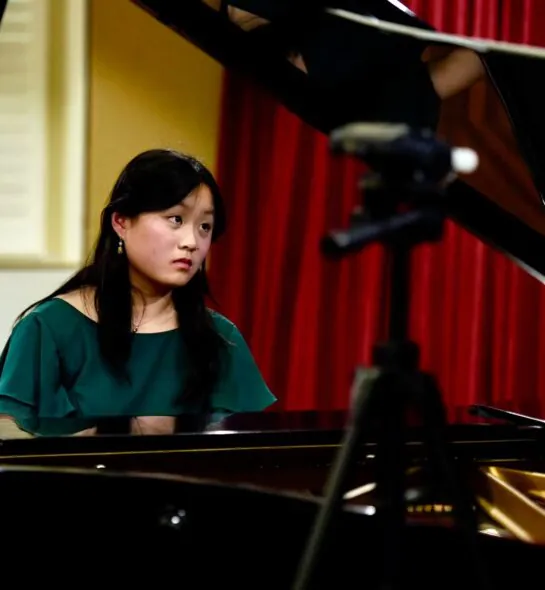
One of the main challenges of this project was translating something as fluid as music into a framework that could be useful in a clinical setting. I didn’t want to reduce classical piano to a “formula.” Much of my own music making is expressive and intuitive, but for a music knowledge base to be useful, annotations need to be consistent across different patients and contexts. So, I began with solo works spanning the baroque, classical, romantic and contemporary eras. Because I knew these works deeply, I could distinguish my personal interpretation from more measurable and objective musical attributes such as tempo, texture and harmonic rhythm. Another challenge was defining the limits of my expertise. I am a musician, not a licensed music therapist, so I was careful to make the database descriptive rather than diagnostic or prescriptive. To conduct the work responsibly, I researched music therapy literature and terminology. Dr. Labazevitch worked with me to refine my solo portfolio; VJ Hyde of Children’s National Hospital and other music therapy professionals helped me understand the workflows of music therapy, providing valuable feedback on the prototype.
My project aims to bring the power of music to more people in underserved communities in two ways: It provides recordings that connect with and inspire listeners, and it utilizes the AMKB tool to ease the operational burden on music therapists, allowing them to focus their energy on serving more people. By enabling therapists to sift through a large catalog of music recordings, the AMKB tool matches music characteristics with clinical needs efficiently. I hope that streamlining the process will increase the affordability and accessibility of mental health care for those who need it most. Moving forward, I hope to scale this tool from a classical piano-based prototype into a broad community resource that music therapists and listeners can rely on. I plan to collaborate with experts, including fellow musicians and music therapists, to incorporate more instruments, genres and age ranges.