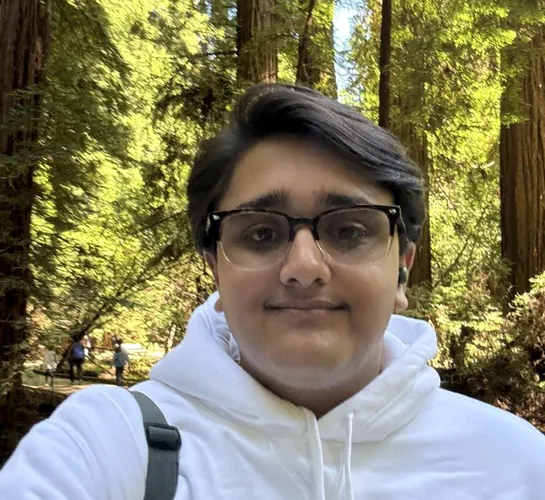
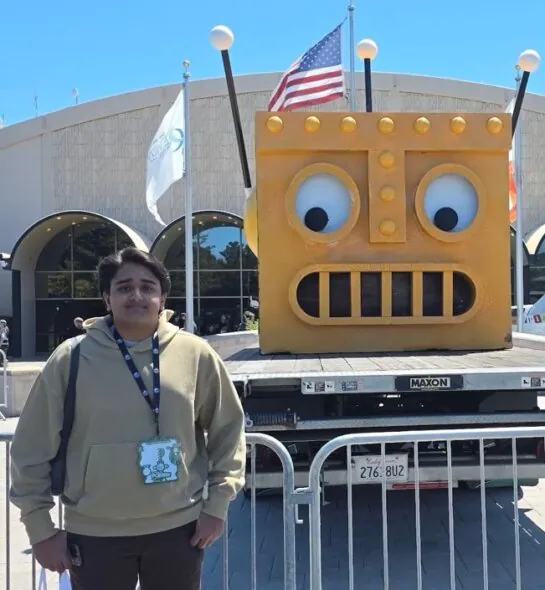
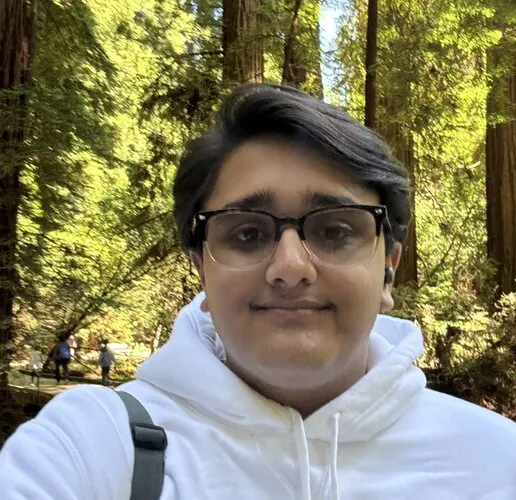
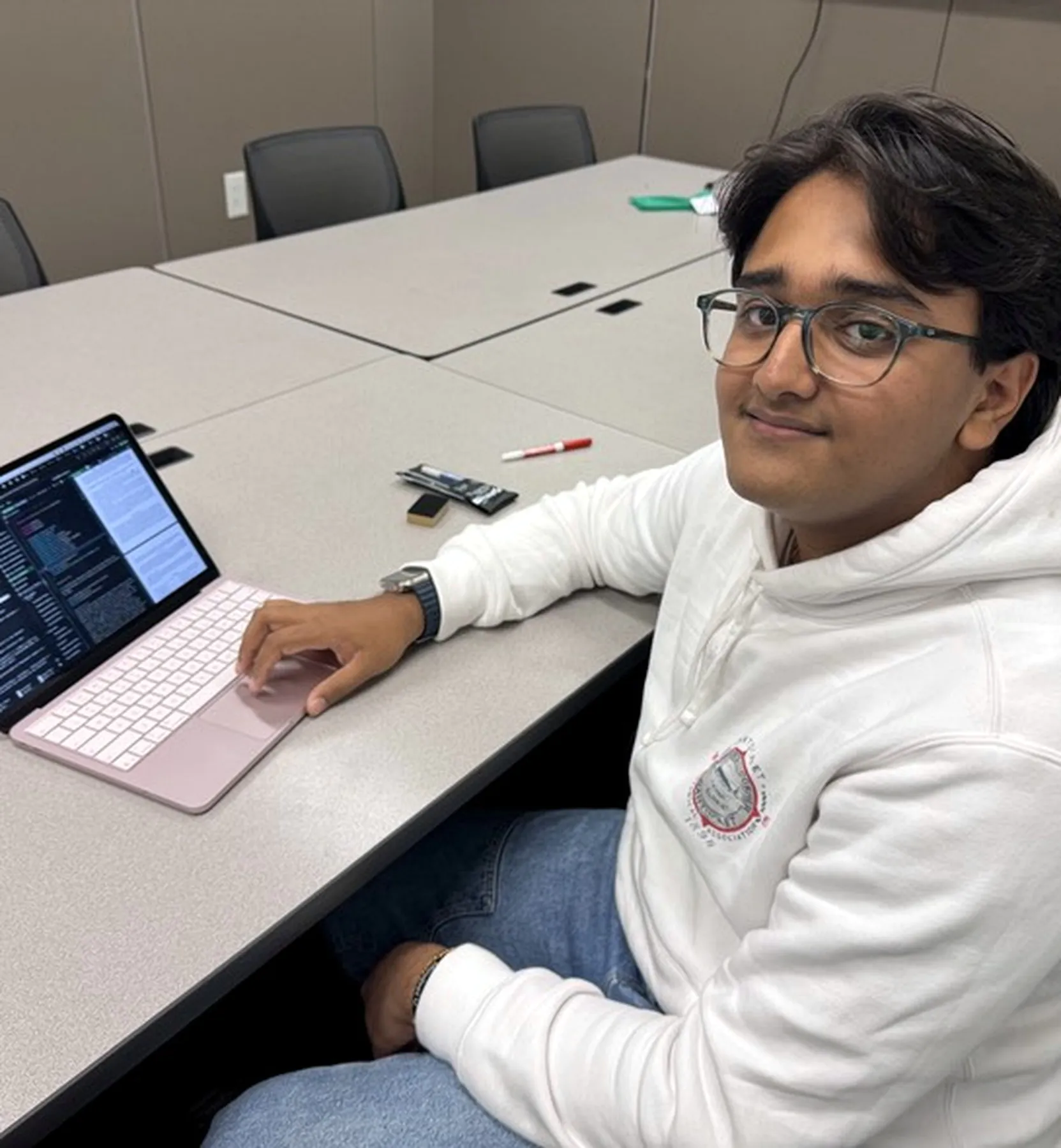
Hitaishi Chillara

Hitaishi Chillara

2026 Davidson Fellow
$50,000 Scholarship

Age: 17
Hometown: Leander, TX

Science: "Connecting Supermassive Black Hole Growth to Observables: A Framework Using Cosmological Simulations and LSST Predictions"

About Hitaishi

My name is Hitaishi Chillara, a student from Leander, Texas, attending the Texas Academy of Mathematics & Science.

My interest in machine learning began with a toy robot dog. I wondered how it stayed balanced while walking, which led me from inverse kinematics to robot learning and eventually machine learning. I hope to pursue research connecting AI, astronomy, robotics and scientific discovery. Outside of research, I help run my school’s space and robotics clubs, compete in cybersecurity and tutor physics and mathematics. My honors include a silver medal in the U.S. Physics Olympiad, a Gold Honour in the International Astronomy and Astrophysics Competition and selection for Team USA at the International Artificial Intelligence Olympiad.

In college, I hope to study astrophysics and electrical engineering.

Skip testimonial carousel

"I am grateful to be named a Davidson Fellow, and I admire the Institute’s values toward aspects of science that are often invisible at first: finding out not only what research can do, but also where its boundaries lie, so that we may ask better questions. For me, the award is an opportunity to share my habit of careful questioning, and I hope that I can inspire youth to do the same."

Project Description

When we observe our universe, we see supermassive black holes and the galaxies that surround them, called host galaxies, appear to evolve together. However, directly measuring a black hole’s mass is difficult for all but a small number of galaxies. In my research, I developed a computational framework that combines simulations of our universe, telescope observations and machine learning to test whether colors and brightnesses measured by surveys of the sky contain any clues about a black hole’s mass.

I compare several simulated universes and use controlled tests to separate signals from the host galaxy’s stars from signals produced as a growing black hole actively feeds. This approach identifies what broadband imaging, with telescopes essentially acting as sophisticated cameras, may reliably reveal through photometry and what questions still require further telescope data. My work can help scientists use the enormous datasets from surveys such as the Vera C. Rubin Observatory’s Legacy Survey of Space and Time to study how galaxies and their central black holes evolve together.

Deeper Dive

With the advent of the Vera C. Rubin Observatory’s Legacy Survey of Space and Time (LSST), the field of astronomy will have access to an unprecedented volume of imaging data. My project studies whether the light measured from a galaxy can reveal information about the supermassive black hole at its center. Black holes can prove to be uncooperative data sources, though; they do not signal their masses when we survey them. So, I worked on a computational framework that combines simulations of our universe with telescope data and machine learning to tell us what qualities of black holes we can discern. By comparing several simulated universes, I can determine which signals are reliable and which questions require more than photometry, allowing us to better understand how galaxies and their black holes evolve together.

In astronomy, machine learning may not be an ideal tool because it can function as a black box, so it is important to understand whether it truly learned what you wanted it to or found some shortcut to get the same result. I built a pipeline that trained on multiple cosmological simulations with various assumptions about black hole growth, looking for which assumptions remained consistent and could potentially translate to our real universe. Dr. Ryan Farber, my research mentor at Purdue University Fort Wayne, helped me place these results in an astrophysical context. I remember him repeatedly pushing past a convenient result to ask the question: “What explains this?” Through repeated analysis to determine whether the results could be manually understood, we were able to refine the model’s results into not only something that performed, but something we could understand.

This work is valuable because time to use telescopes is limited. A survey can collect billions of images of galaxies, but measurements, especially for black hole analysis, are much harder to obtain. By establishing what simple, broadband photometry, like a camera, can reliably tell us through learned signals, this framework can help scientists make more informed decisions when estimating black hole quantities, such as mass. I hope that the key methodological steps I took can make returns from public datasets and sky surveys more accessible, interpretable and useful.

Q&A

If you could have dinner with the five most interesting people in the world, living or dead, who would they be?

Richard Feynman, Srinivasa Ramanujan (I’ll make sure his cab is numbered 1729), Grace Hopper (bringing a few nanoseconds in case we’re running late), Enrico Fermi, and Stephen Hawking (I’ll send his invitation after dinner).

What is your favorite tradition or holiday?

For a while, on Pi Day, March 14th, we’ve gotten a key lime pie at a bakery to celebrate, and it’s become one of my favorite traditions.

What are the top three foreign countries you'd like to visit?

I’d like to visit Iceland, Australia, and China, mostly because they’re countries I haven’t been to, and also because they’re in very different regions of the world that I’d want to explore.

Skip carousel

Click image to download high resolution files

In The News

Hitaishi Chillara, 17, of Leander, has been awarded a $50,000 Davidson Fellows Scholarship for his science project, Connecting Supermassive Black Hole Growth to Observables: A Framework Using Cosmological Simulations and LSST Predictions. The Davidson Fellows Scholarship is one of the nation’s most prestigious honors for students 18 and younger.

Download the full press release here