Deeper Dive
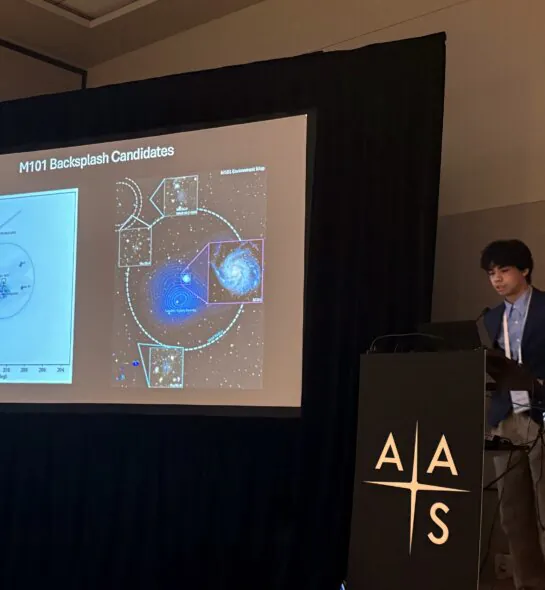
My project describes the discovery of three backsplash candidate galaxies in our local universe and their implications for tests of our cosmological model. The galaxies are both isolated and devoid of star formation, an extremely rare configuration that challenges our understanding of galaxy formation, as dwarf galaxies typically require a larger neighbor to remove their star-forming gas. My paper, which has been accepted for publication in The Astrophysical Journal, proposes that they are potentially “backsplash” galaxies, having passed close to a Milky Way mass host before moving into isolation.
While simulations have long predicted these objects, no backsplash galaxies have been confirmed in our local universe, which inspired me to search for them based on their theoretical distribution. I analyzed the candidates as a direct test of expectations from our standard cosmological model and developed a new methodology for predicting the abundance of dwarf galaxies near larger hosts by considering dark matter and environmental density. These tests will be especially useful as upcoming surveys such as the Rubin LSST uncover potentially dozens of backsplash galaxies, enabling a critical examination of whether theory matches observations.
My project required skills in cosmological simulations, coding to measure the physical properties of dwarf galaxies and modeling the formation of galaxy haloes, all of which were challenging to learn and apply without formal astrophysics training. Exploring the literature in AAS, RAS and A&A journals helped me understand specific techniques in the field. A particular challenge was estimating the distances to the dwarf galaxies, which is critical to understanding their nature. I originally attempted to use the brightness distribution of the galaxies’ stars as a “standard candle,” but ultimately switched to a more robust measurement using fluctuations in the galaxies’ surface brightness.
I envision my work serving as inspiration for young people aspiring to pursue research in astrophysics. School curriculums often provide limited introductions to astronomy, making it difficult for students to find mentorship and build experience in the field. My paper demonstrates that public archival telescope data can be a valuable tool for making new discoveries about cosmology and the evolution of our universe, and that young astronomers are capable of contributing to these discoveries. With the extensive datasets expected from the Rubin and Roman observatories, I hope others are encouraged to make scientific discoveries that deepen our understanding of cosmology.