Raffaello Banin

Raffaello Banin

2026 Davidson Fellow
$25,000 Scholarship

Age: 17
Hometown: Piedmont, CA

Science: "Decoding Protein Folding Pathways"

About Raffaello

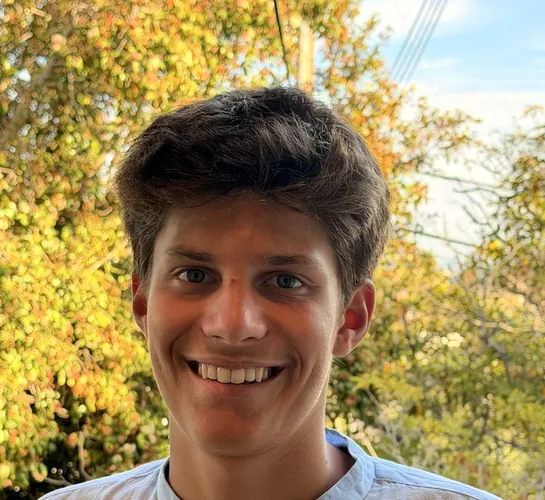
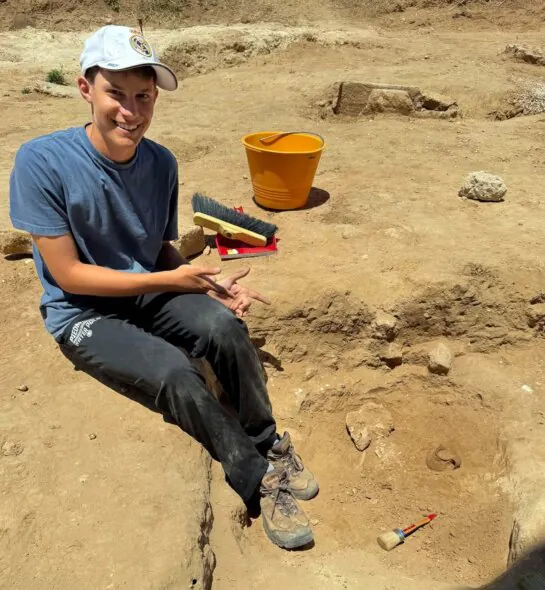
My name is Raffaello Banin, and I am an incoming high school senior from Piedmont, California. I was born in Italy and moved to the United States when I was five. I am a native speaker of English, Italian and Hebrew. I am driven by the thrill of discovery, whether unearthing an archaeological artifact, decoding a scientific mystery or finding the perfect melody.

I hope to pursue a career exploring science while crossing traditional boundaries between disciplines. My interests in biology, music and archaeology have taught me to look for patterns and stories that are not immediately visible and to approach questions from different directions.

Music is also a major part of my life. I play violin and electric guitar, compose across genres and have released rap music on Spotify. I wrote an opera performed in San Francisco and Trento, Italy, and recently launched my record label, RAFFER, to support young musicians and engage underserved communities through music. I also play water polo and love sailing.

Skip testimonial carousel

"To me, being named a Davidson Fellow is a tremendous honor. Just as my curiosity has led me to connect seemingly different worlds, from archaeology and music to proteins, I am excited to learn from other young people whose curiosity has taken them in different directions. More than recognition of what I have accomplished, I see this as an opportunity to form new connections, explore new questions, and discover where my curiosity might take me next."

Project Description

My project investigates one of biology’s fundamental questions: How does a protein transform from a simple chain of amino acids into the precise three-dimensional structure it needs to function?

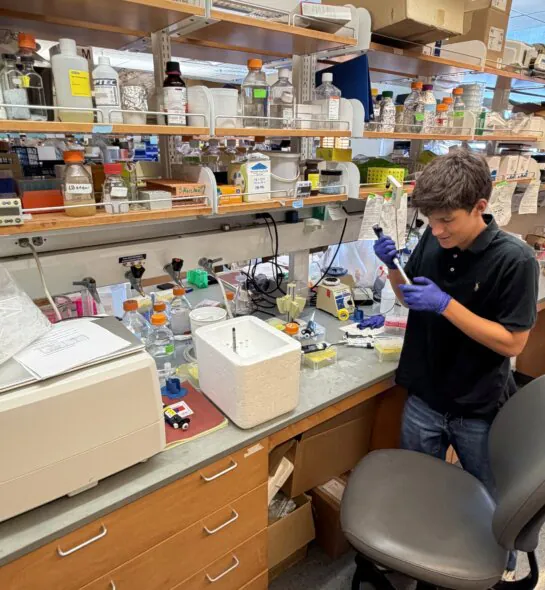
I studied two structurally different proteins, CP2 and RNase H, using optical tweezers to pull on individual molecules and measure nanometer-scale changes in their length as they folded and unfolded in real time. I also redesigned the molecular attachments to improve the stability and precision of these measurements. With RNase H, I engineered flexible loops between specific structural regions, allowing me to connect each measured change in length to the part of the protein that was folding or unfolding.

Across many individual molecules, I identified three reproducible intermediate states that appeared in a consistent order. This provided direct single-molecule evidence that proteins can assemble through cooperative structural units called “foldons” and allowed me to begin mapping the pathway from amino-acid sequence to final structure. Understanding these hidden pathways, and where proteins can become trapped or misfold, could ultimately improve our understanding of protein-misfolding diseases and help guide the design of proteins with new biological functions.

Q&A

If you could have dinner with the five most interesting people in the world, living or dead, who would they be?

Eddie Van Halen, 50 Cent, Mozart, Einstein, Nikola Tesla

What is one of your favorite quotes?

"He who has a why to live for can bear almost any how." — Friedrich Nietzsche

What are the top three foreign countries you’d like to visit?

I would like to visit Japan, Go on a Safari in Tanzania, and go to Brazil.

Deeper Dive

I have always been fascinated by how science can uncover stories about human life that would otherwise remain hidden. Growing up, this fascination drew me to archaeology and ancient Egypt, and to the dream of one day finding something hidden for thousands of years. I remember reading that through proteins preserved in ancient remains, scientists were able to discover evidence of inflammation and immune responses in our ancestors.

I found it extraordinary and, at the same time, puzzling. How could something so small carry traces of human life across millennia, yet something as subtle as a change in its shape contribute to devastating diseases like Alzheimer’s? How does a protein find its right shape in the first place?

The opportunity to work in a research lab to investigate these questions was a dream come true: a chance to uncover the mysterious journey a protein takes as it folds.

Using optical tweezers, I followed individual proteins as they folded and unfolded in real time and engineered the experimental system to identify which part of the protein was involved in each step. Across many proteins, I discovered a repeatable progression through three intermediate states, showing that folding is not a random event but a predictable, step-by-step pathway.

One of the first challenges I faced was noise. The changes in protein length I was measuring were only a few nanometers, making real folding events difficult to distinguish from experimental noise. After repeating the experiment several times to minimize errors, I realized that improving the data required making the molecular construct itself more stable. I redesigned the molecular attachments until I obtained cleaner, more stable measurements.

A second challenge was determining which part of the protein produced each intermediate state. To solve this, I engineered flexible loops between specific structural regions, allowing me to identify which areas were folding and determine their order.

Protein folding is fundamental to every biological function throughout our bodies, from the way we breathe to the way we think. When proteins misfold and aggregate, they can contribute to diseases including Alzheimer’s, metabolic disorders and blindness. My work identifies critical “checkpoints” in the folding process, revealing where and how folding can go wrong. Uncovering these pathways could ultimately help researchers develop more targeted strategies for preventing or treating diseases caused by protein misfolding.

Beyond human health, the same principles could help engineer synthetic proteins with new functions, such as breaking down pollutants or creating sustainable biomaterials. By decoding the rules that govern how proteins build themselves, I hope my work can contribute to better approaches to human disease and new biological solutions to some of our planet’s greatest challenges.

Click image to download high resolution files

In The News

Three Bay Area teens have been named 2026 Davidson Fellows, one of the nation’s most prestigious honors for students 18 and younger. Ruoqi Li and Jason Yang of San Jose and Raffaello Banin of Piedmont will share $125,000 in scholarships.

Download the full press release here