Deeper Dive
My project, A Comprehensive Eco-friendly Strategy for Citrus Greening Disease Management, began with a problem that was deeply personal to me. As the daughter of a Florida citrus grower, I watched citrus greening disease damage our trees and threaten the livelihoods of farming families throughout the state.
While researching the disease and possible treatments, I came across a novel concept: the curry leaf plant was a susceptible host for the disease vector; however, when the vector fed on the plant, it became noninfective. This intriguing phenomenon suggested that the curry leaf plant contains certain groups of compounds that neutralize the bacteria or interfere with disease transmission.
Building on this, my research focused on using curry leaf extract as a novel treatment for citrus greening disease, identifying potential therapeutic compounds and engineering tools to diagnose and improve the efficacy of my treatment.
In my investigation, I initially developed a curry leaf extract-based bactericide formulation and injected it into the trunks of trees infected with the bacterial pathogen.
Next, I investigated the potential of steam therapy as a supplemental treatment to enhance treatment uptake. I developed a Localized Thermal Therapy System using phase-changing materials and salt chemistries for sustained heat release around tree trunks. The objective was to induce transpiration, increase sap flow in the vascular tissue and mobilize treatment uptake more efficiently throughout the plant.
Finally, I developed a YOLOv11-based computer vision application as an in-field diagnostic tool to quantify disease severity based on visual symptoms on the leaves. Because farmers do not have access to laboratory equipment such as qPCR or ELISA, I wanted to ensure they had an accessible tool to monitor the efficacy of my treatment and the health of their groves.
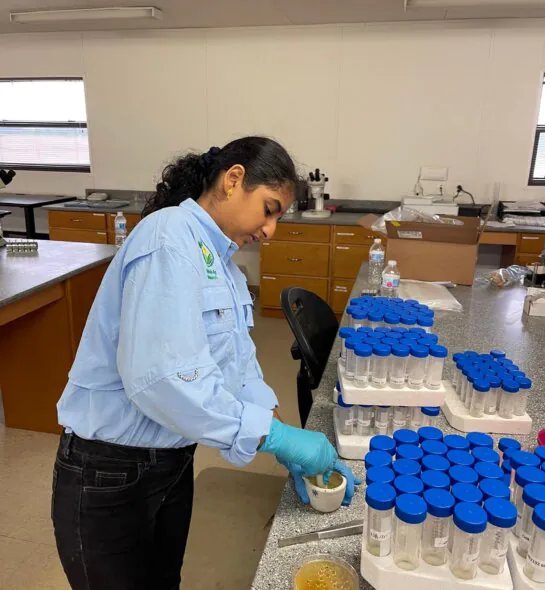
Completing this project taught me that research rarely progresses in a straight line. My first extraction procedures produced only about a 10% yield, so I had to repeat the process 10 to 12 times to obtain enough material for testing. I responded by calculating how much curry leaf material I would need and planning each extraction more carefully. Another challenge emerged when conventional trunk injection syringes leaked and injured the trunks of young citrus trees. While waiting several months for the biological results of my greenhouse trials, I designed and tested multiple 3D-printed prototypes until I developed a smaller, nonpressurized infusion system that delivered the treatment more effectively. I completed more than 300 hours of research, often working in the laboratory for two hours after school every other day. My IB Biology, mathematics, statistics, chemistry and biotechnology courses helped me substantially in designing experiments, analyzing data and gaining a theoretical foundation, although many of the specialized techniques required independent learning. Starting this research as a freshman, I faced a huge learning curve, spending hours learning specific laboratory techniques, coding skills, CAD modeling and multiple biological concepts.
I hope my work gives citrus growers hope and can help support the rejuvenation of citrus farming in Florida. For a grower, a healthier tree is more than an experimental result. It can mean protecting land, preserving a livelihood and continuing an important part of Florida’s history and identity. Because my treatment is eco-friendly and less expensive than conventional antibiotic treatment, it could reduce agricultural chemical inputs while making disease management more accessible to growers. The engineered steam therapy system can assist in improving treatment uptake, while the web-based diagnostic tool could allow growers to monitor changes in their trees using an ordinary photograph. I have also spoken directly with growers about citrus greening management, and those conversations continually remind me who this research is meant to serve. Beyond citrus greening, the same biological treatment and thermal therapy framework may eventually be adapted to other bacterial, fungal and vascular plant diseases. I hope this work contributes not only to healthier trees but also to stronger farming communities and a more sustainable agricultural future.