The following excerpt is adapted from Make Your Worrier a Warrior – A Guide to Conquering Your Child’s Fears by Dan Peters, Ph.D., published by Gifted Unlimited, LLC. You can find the book in Gifted Unlimited’s bookshop. In this passage, Dr. Peters explores how thinking errors, sometimes called “stinking thinking,” are unhelpful or irrational thoughts that can make children feel more worried and scared. Recognizing patterns such as catastrophizing, all-or-nothing thinking, filtering, selective attention, magnifying, and “shoulds” can help parents understand what is driving their child’s worries and help the child respond in a healthier way.
Catastrophizing
A person who visualizes that disaster will strike at any time, who thinks that the worst possibilities are going to happen, and who feels like she won’t be able to handle it when they do happen is catastrophizing. “If don’t do well on this spelling test. I’m never going to get into college!” “I will never have any friends!” “Mom is five minutes late already—I’m sure she’s gotten into a horrible car accident! How will my life change if I don’t have a mom?” To others, the catastrophizing is clearly unreasonable, but to the individual battling such thinking, the thoughts seem certain outcomes to the situation at hand.
All or Nothing Thinking
This kind of thinking is also called black and white thinking because there is no middle ground, no gray area. It’s an inflexible and irrational style of thinking because it implies that no middle ground exists between extremes; it is “always” or “never.” It is extreme thinking—that we either have to do things perfectly or have failed, that people either like us or hate us. We often see examples of all or nothing thinking in reference to a child’s grades, as in an A means success, but a B or any other grade is failure. Getting a B, particularly in a subject that is hard for a student, may be a blessing in disguise, since it can force the child to see that the world didn’t come crashing down just because he didn’t bring home all A’s.
Filtering
Filtering means focusing on the negative aspects of a situation while ignoring the positive parts. As an example, let’s say that your child got invited to a party she very much wanted to go to, but when she gets home, she only focuses on the times at the party when she didn’t feel included. Or even though your child had a lot of fun at the school picnic, she only thinks about the part of the picnic when the kid in front of her took the last bag of Doritos and she had to have plain potato chips. Filtering can also be described as “bad bookkeeping,” in which one bad thing outweighs all of the good things in a situation.
Selective Attention
Selective attention is similar to filtering. It is when a person looks for aspects of a situation that are consistent with and confirm his beliefs about something while at the same time ignoring information that goes against what he knows to be true. A child might say, “My coach thinks I didn’t play well and that I need to work harder,” when in fact the coach actually made several positive comments and offered constructive criticism about only one play the child made. Or a child might say, “I can’t believe I missed that question! How stupid can I be?!” in response to missing one out of 100 questions on a test.
Magnifying
When a child magnifies an event or an issue, he is blowing it out of proportion or making it seem bigger and worse than it really is—for example, “I made a mistake, and now everyone is going to laugh at me every time they see me,” or, “I failed the test, and now my future is ruined!” or, “When I was giving my presentation to the class, I dropped my pen, and now everyone thinks I am clumsy and stupid. And they won’t want me to play kickball with them ever again.” Intense children are particularly likely to magnify.
Shoulds
This thinking error refers to “rules” that some people have about how things should be. The rules might be about their home, their school, or the entire world, and they are identifiable when your child uses words like should, have to, and must to explain how things “should” and “must” be. “I should not make mistakes.” “I have to always do things perfectly.” “I must always get 100% on tests.” “I must know more than everyone else.” Also, “would haves” and “could haves” similarly create uncomfortable feelings in children that can make them feel despondent for hours, days, months, or even years. “I would have gotten an A if the
teacher hadn’t put in a trick question.” “I could have been the top speller, but I got a really hard word.” “I could have gotten first place, but I let Jason win.” Watch out for “shoulda.. .woulda.. .coulda…”!
Mind Reading
Mind reading is what a person does when she thinks she knows what others are thinking—particularly when it comes to what they are thinking about her. Some kids always assume that others are thinking negatively or badly about them. “They think I’m stupid.” “They don’t want me to play with them.” “I can tell you think I’m a bad singer. Mom. You keep saying nice things, but you don’t really mean it.” “I can tell you’re mad because you keep reading the paper and ignoring me.” Usually, these kinds of assumptions also involve an imaginary audience—that is, the child is absolutely sure that everyone is watching and will know the mistake she has made.
This is only a selection of the thinking errors Dr. Peters explores in Make Your Worrier a Warrior. The full chapter includes additional examples and practical ways to help children recognize and push back on the unhelpful thoughts that fuel worry.
See also:
Permission Statement
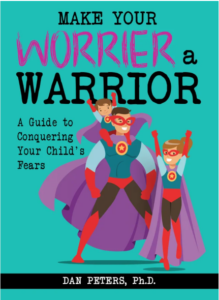 Permission to reprint this text was granted by the publisher, Gifted Unlimited, LLC. This is an excerpt of the book, Make Your Worrier a Warrior – A Guide to Conquering Your Child’s Fears by Dan Peters, Ph.D. For the full book and more from Gifted Unlimited, visit Gifted Unlimited’s bookshop. Dr. Peters’ book offers additional guidance for helping parents and children understand anxiety, recognize unhelpful worry patterns, and manage fears with greater confidence.
Comments