JAN DAVIDSON
Founder and CEO of Davidson & Associates Inc.,
educational software publishers
An interview with Jan Davidson, co-founder of the Davidson Institute, from Margery Mandell’s 1996 collection of self-made success stories, Self-Made Americans: Personal Interviews With Dreamers, Visionaries & Entrepreneurs
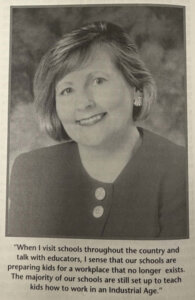
Jan Davidson is a woman with a mission. “I just want to change the world,” says the president and founder of Davidson & Associates, Inc., one of the largest educational software publishers in America today. What Davidson may lack in modesty of ambition, she more than makes up for in experience, determination, and vision.
Over the last twelve years, this former high school and college teacher has built one of the top three American companies to develop, publish, and distribute a wide range of IBM/PC and Macintosh-based educational software products. Using her own teaching experiences as a starting point, Davidson was one of the earliest champions of using computer technology to revolutionize the classroom learning experience.
As with most missionaries, Davidson has spent countless hours spreading the word and looking for converts — in this case, America’s educators. But the world has finally caught up with her ideas. Today the educational software industry is taking the country by storm, and Davidson & Associates is at its epicenter. Industry-wide, school sales of educational software reached $585 million in 1991 and are projected to grow to $1.45 billion by 1996. In that same period, home sales of educational software are projected to triple to $300 million. Davidson & Associates is leading the way with a list of more than twenty-five award winning titles that teach math, reading, and writing skills, as well as history and science, to an audience that ranges from small school children to their parents and teachers.
 Davidson’s Math Blaster learning series, designed to teach math fundamentals to kids age six to twelve, has already sold well over a million copies since it was brought on the market more than a decade ago, and that was just the beginning. Today the company has agreements with such prestigious partners as Simon & Schuster, Addison-Wesley, and Fisher-Price to develop, produce, and distribute multimedia products for the consumer, education, business, entertainment, and reference markets.
“As a nation, we are only as strong as our people,” says Davidson. “I believe I can make the nation stronger through education, and technology is one of the best means to achieve this.” When she speaks about the future of education, Davidson’s hazel eyes flash with a blend of fresh enthusiasm and fierce commitment. The combination is compelling. The petite schoolteacher in the trim red blazer and black slacks metamorphoses into a veritable Joan of Arc, leading her country’s schoolchildren to a higher quality of life —life in the Information Age, that is.
“When I visit schools throughout the country and talk with educators,” she continues, “I sense that our schools are preparing kids for a workplace that no longer exists. The majority of our schools are still set up to teach kids how to work in an Industrial Age. But the world these kids are going to face is an Information Age — a fast-paced global marketplace where American success cannot be automatically assumed. It’s [as foolish as] teaching mileage when all the road signs are in kilometers, or using a map from the 1950s to explain what’s going on in Bosnia…
 “In Information Age classrooms, students will learn to access information and work with what they discover. They will move through the schoolday similar to the way their adult counterparts move through the workday. They will manage their time. They will use tools. They will have teammates. And they will take responsibility for a given task, leverage their skills, ferret out information needed to solve a problem, and work with classmates to get the job done.
The offices of Davidson & Associates in Torrance, California, about a half-hour’ drive south of Los Angeles, look like Hollywood’s version of the headquarters for an industrial giant. The impressive structure arcs into a majestic glass and stone semicircle supported by elegant, soaring columns, with the name Davidson emblazoned in authoritative letters across its facade. It could be the set for a movie about a country girl from the Midwest who rises to become the president of a $60 million company. If it were, then art would most certainly be imitating life.
Born in Ft. Knox, Kentucky, in 1944, Davidson and her younger brother and sister grew up in Frankfort, Indiana, where their father managed a local dairy. “I learned a lot about business from my parents,” recalls Davidson. “They started their own business distributing dairy products to grocery stores and finally opened their own chain of convenience stores. My parents were always resourceful in making ends meet and taught me to do the same . . . They raised me in an environment that made me believe I could do anything I wanted to do. They had a real can-do attitude. No one ever talked about failure, and, as a result, I had incredible self-esteem.”
By the time she was thirteen, Davidson was earning money as a tutor in her home. Her interest in teaching never faltered in the years that followed. She was the first in her family to go to college, obtaining her undergraduate degree from nearby Purdue University. It was at Purdue that she met her husband, Bob Davidson, whom she married in 1966, just a week after graduating.
 The couple moved three times over the next ten years, living first in Maryland, where Davidson obtained a master’s degree in communications and a doctorate in American literature from the University of Maryland, and finally settling into the home they still occupy in Palos Verdes, California, in 1976. “Every time we moved, I got a different teaching job,” recalls Davidson. “I think I taught every year between the ages of thirteen and forty.”
In 1979, Davidson founded Upward Bound, a non-profit tutoring service in a classroom she leased at Palos Verdes Elementary School. Proposition 13, a tax-cutting measure that led many California school districts to end the schoolday at noon, was instituted at the time, making Davidson’s after-school classroom an instant success. “People didn’t know what to do with their kids all afternoon, so they brought them to me,” recalls Davidson.
She hired several teachers to oversee courses in language skills and remedial math, and the program gradually grew to accommodate students of all ages, from second grade all the way to adult. “The pedagogical [movement] at the time was towards individual instruction,” explains Davidson. “We have learned a lot about learning in the last few decades, including the fact that we all learn differently. Traditional schools were focusing primarily on only two learning skills — the verbal and math intelligences — leaving all others, such as creative or analytic skills, basically untapped… We could see that the best learning environment was student-centered, allowing each student to learn at his or her own pace and in his or her own style. And we could see that computer technology would allow students to learn in the way that was best for them.”
Shortly after starting Upward Bound, Davidson purchased her first Apple II computer, hoping to customize her speed- reading course to accommodate individual students’ needs. The effort of computerizing the course led Davidson to meet with a friend who knew enough about programming for the Apple to create Speed Reader and then Word Attack for teaching vocabulary skills and, later, Math Blaster, a game for developing math skills that enabled kids to solve a math problem and shoot a man out of a cannon.
 “I knew virtually nothing about technology,” adds Davidson with a laugh. “I never had a computer course. I just learned what I needed to do and surrounded myself with people who were smarter than I am. What I could see was the incredible potential of technology. It could help educate people and actually improve their quality of life, and I had to convince other educators of that.
“In the early days, people were concerned that computers would dehumanize education. I knew, however, that computers could be a socializing force. For one thing, each of us learns differently and computers enable a teacher to individualize instruction. For another, computers are much more patient than humans are. Finally, a good piece of software — one that has a strong educational foundation and that is engaging and appealing to a child — empowers students to think, analyze, and create.”
Speed Reader, Word Attack, and Math Blaster were virtually instant successes. Parents began requesting copies to run on their home computers and Davidson and her kids — then eleven, eight, and six — turned their house into a production plant. They took turns copying disks off their home computer and then shrink-wrapping them for shipment to a growing marketplace.
Davidson turned the production business over to Apple in 1983 but a year later decided to get out of the mail-order business and go back to teaching. “I grew up in a time when women were supposed to be wives and mothers,” says Davidson. “Bob was working long hours as an executive vice president at Parsons, an international engineering and construction firm in Pasadena, and I already had enough on my plate.”
She planned to sell the software she had developed to an outside publisher and arranged a lunch meeting at a local restaurant chain with a small San Diego-based company. As luck would have it, however, the publisher went to the right restaurant in the wrong town and consequently never arrived for their scheduled meeting. Davidson had brought her husband along for the meeting, and as the two waited futilely for their guest to arrive, Bob managed to convince his wife that she would never be happy leaving her product in the hands of someone who cared less about education than she did and that she should do it herself.
Shortly thereafter, the couple borrowed $6,000 from their three children’s college funds and started Davidson & Associates, packaging Speed Reader in a school notebook-style three- ring binder. Within a year, they sold over 5,400 copies at a net profit of $50 each and used the proceeds to develop new software. The company started with a handful of employees working out of eleven rooms leased out of an abandoned local elementary school. Today, more than 400 employees work for Davidson & Associates in the 44,000 square-foot installation they are now expanding to include a brand-new research and development center and a sound production studio.
 “We had a great babysitter. Computers were a novelty and my kids were very interested in them; [and] working with educational software meant I was around schools —and often their school — and the kids liked that,” says Davidson of her ability to juggle career and family at the time. “Besides, I think I was afraid I might start living vicariously through my children if I didn’t go back to work…
“But what really drove me was an abiding belief that I could make a difference. There was never any need for me to come to work for the money. In fact, to this day, I argue constantly about my salary with my board of directors. They tell me I need to take a salary. I tell them I do it because I need to teach. I find it invigorating and satisfying. I have always been extremely goal-oriented. I’ve never managed moderation well. I either do things completely or I don’t do them at all.”
The company grew by leaps and bounds and Davidson realized she desperately needed a chief executive officer to handle the company’s administration. It wasn’t until 1989, however, that she managed to recruit her first choice — her husband Bob. “As a lawyer and a business school graduate, and, of course, as my husband and chief supporter, Bob was obviously ideal for the job, but I didn’t want to force my dream on him,” says Davidson now. “I feel the same way about my kids. My oldest daughter, Elizabeth, now works as an analyst for Smith Barney on Wall Street; my second oldest daughter, Emilie, is a student at Pepperdine; and my son John is entering his first year at El Camino College. Though I couldn’t have built this company without them, I would never expect them to follow my dream.
“But Bob was a different story. His dream was to build a family business and to create something from nothing, and this was a perfect opportunity for him. The business works well for us. We have complementary objectives, skills, and styles, and we have the same values. He’s more competitive with outside people and companies. I’m more interested in how I am doing against my own internal objectives and goals. You need to be [both] outwardly competitive and inwardly competitive to run a business successfully.
“Bob runs the financial aspects of the business from the second floor. I stay on the first floor, overseeing the creative side — new products, research and development, and production . . . When you care as much about your business as I do, it’s a great comfort to have someone you love sharing it with you, and he’s certainly having a lot of fun.”
When Bob joined the company, he implemented what he called a “studio strategy,” similar to the system that evolved out of the movie industry of the 1920s. The key to the success of the studios was to have different sources of product and to build strong channels for distributing the products to the marketplace. Although most small software companies allow others to handle their distribution, Davidson & Associates are determined to own the rights to all of their programs and to deal directly with large consumer accounts like Software Etc.
“In fact, there is no ‘typical’ Davidson deal,” says Jan. “We have no one fixed way of doing anything. . . First, there’s our publishing arm, which comprises the vast majority of our business. We design our own product in-house, using our own sound, graphics, and animation facilities. Then we package, market, and distribute it ourselves. Then, there is our affiliated label program, wherein we act as a distributor for other titles which are published by other companies under their own label. These companies come to us for our expertise in marketing, distribution, promotion, and packaging.
“We also have something called ‘third party development.” If an individual has developed a product to some extent but does not want to put that product out under their own label, we will work with them and put it out under the Davidson label. Sometimes we have the ideas, and a third party will develop it for us.
“What’s more, we have a number of what we call ‘strategic alliances.” These are partnerships with companies such as Addison-Wesley, Fisher-Price, and Simon & Schuster, in which we create products together and share in the marketing, distribution, and profit. Simon & Schuster, for example, has over 300,000 book titles in their library from which we will be able to create a range of multimedia products.
“Finally, thanks to Bob’s mergers-and-acquisitions experience, we have acquired a number of companies that will help us grow. In 1992, we traded 9 percent of the company’s equity for Educational Resources in Elgin, Ill. Educational Resources is the largest reseller of packaged software to schools and offers over 1,200 titles in subjects ranging from algebra to zoology. This gives us a considerable advantage in the school market.
“We also acquired First Byte, which has developed wonderful technologies to convert text into synthesized speech. We have incorporated this into several new Davidson’s products, including Kid Works 2, a painting and word processing program, and The Cruncher, a spreadsheet program for kids.”
Their most recent acquisitions are Learningways, an educational software developer in Massachusetts, and Blizzard Entertainment, a leading entertainment software developer known for titles such as The Lost Vikings, Rock and Roll Racing, and The Death and Return of Superman.
 All of this means astronomical growth in three areas: consumer products, educator products, which include software plus a variety of teaching materials, and what Davidson calls, “school-only curriculum systems,” which comprise CD ROM software, laser disks, audio cassettes, teachers’ guides, and oral and written activities to be used in a classroom setting. It also means astronomical growth within Davidson & Associates.
The company has recently expanded to include a new warehouse the size of three football fields and is now rebuilding their back offices to house a production studio as well as 345 new employees.
“I like to think of the company as a collection of self-directed work teams,” says Davidson, who cites Tom Peters’ two books, In Search of Excellence and Liberation Management, as important sources of inspiration in building her company. “We give each team a lot of responsibility and we like to let them plan how best to accomplish their objectives. We think people work harder when they are given a lot of responsibility. They may make mistakes, but that’s okay. The way you learn is by making mistakes. I know that; I’m a teacher. We like to grow people and expect them to get better and better, and we try to provide an environment for that growth. I look for people who have a desire to take responsibility and who have a passion for what we do. They have to love kids and love learning. We don’t hire people to do a job; we hire them to pursue a mission.
“In Liberation Management, Peters also talks about being customer-centered and adapting a company’s needs to the customer’s, rather than the other way around. In education, the Industrial Age mindset might translate into ‘You can have any education as long as you learn with my teaching tools.” A customer-oriented approach would say, simply, ‘Learn it your way.””
Whatever aspect of her business Davidson is discussing, she always comes back to what’s most important to her — teaching. Since she began the company twelve years ago, she has traveled the country, teaching educators about the importance of introducing computer technology into the classroom. As one-time president and a member of the board of directors of the Software Publishers Association for the past ten years, she has even founded the Computer Learning Foundation, an organization responsible for encouraging computer use in the classroom through such nationwide programs as “October is Computer Learning Month.” Her efforts have most certainly been rewarded. Today, the company boasts that there’s at least one Davidson product in every single school in this country.
And Davidson appears to be enjoying every minute of it. She claims she has “very little time for hobbies,” with the exception of a daily regime of exercise that includes an hour of jogging and working out with a personal trainer. Now that her kids are grown, she confesses, she spends most of her time, including lots of weekends, at work. “You shouldn’t start a business unless you love what you do and you feel it’s important, because you spend an incredible amount of hours doing it,” she offers as advice to anyone starting up a new company. “And try not to be too aggressive. Take baby steps, because you’re going to have lots of failures and that way you’ll never fall too far. Finally, you’ve got to be willing to take risks. It’s less risky than not taking any risks. Risk means change and change means growth. I’m a calculated risk-taker. I pride myself on embracing change.”
Davidson embraces change not just for herself and her company, but for future generations. “Technology can spark imagination and creativity,” Davidson says, concluding with the same intensity with which she began. “I don’t ever want to give the impression that teachers will be replaced. They will just have different tools to work with. The feeling of empowerment a child experiences when he or she learns to use a tool on the computer is similar to the feeling of empowerment a child feels when first learning to ride a bicycle. It’s exhilarating. And I must admit that creating these tools is also exhilarating … Anyone who has seen what a kid can do when let loose on a well-designed computer tool has seen the future.”
Permission Statement
 This text originally appeared in Margery Mandell’s 1996 collection of self-made success stories, Self-Made Americans: Personal Interviews With Dreamers, Visionaries & Entrepreneurs. Chapter reprinted with family permission. Publisher: Gift to the Future 2000
This article is provided as a service of the Davidson Institute for Talent Development, a 501(c)3 nonprofit dedicated to supporting profoundly gifted young people 18 and under. To learn more about the Davidson Institute’s programs, please visit www.DavidsonGifted.org.
Comments