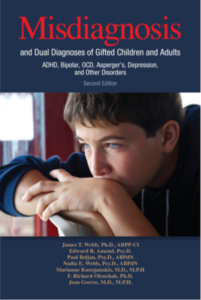
The following excerpt is adapted from Misdiagnosis and Dual Diagnoses of Gifted Children and Adults by by: James T. Webb, Ph.D., Edward Amend, Psy.D., Nadia E. Webb, Psy.D., Marianne Kuzujanakis, M.S. M.P.H., F. Richard Olenchak, Ph.D., Jean Goerss, M.D., published by Gifted Unlimited, LLC. You can find the book in Gifted Unlimited’s bookshop. In this passage, the authors explore why gifted children and adults may sometimes receive inaccurate diagnoses or have genuine needs overlooked. Gifted traits, intensities, and asynchronous development can be misunderstood as signs of a disorder, while disabilities or mental health conditions can also coexist with high ability.
Why Are So Many Gifted Children and Adults Receiving so Many Diagnoses? There are three main reasons.
Overdiagnosis
First, as we have noted, is the tendency in recent decades to overdiagnose and to label quirks as though they were disorders (Gnaulati, 2013; Schlesinger, 2012), and the parallel pressure toward conformity (Robinson, 2015).2 Socialization of children is highly valued in schools as well as for adults in most work situations. However, it is important to realize that quirks are not the same as mental disorders. For example, it is interesting to recall that Marcel Proust wrote most of his novels while lying in bed; Beethoven had such little interest in personal cleanliness that friends had to take his clothes while he slept to wash them; William Faulkner preferred to type with his toes; and Alexander Graham Bell kept his windows covered to keep out the harmful rays of the moon.3
It is doubtful that people have changed that much; instead professionals argue that they are simply getting better at diagnosing and treating abnormal behavior. Yet it seems that an increasing number of behaviors are being considered to be outside the norm and pathological, and since gifted children and adults often show unusual behaviors, this alone raises a concern about overdiagnosis.
Lack of Knowledge About Common Characteristics
Second, there is a lack of knowledge among professionals about common characteristics, resulting in typical gifted behaviors being mistaken for one or more disorders. Professionals such as psychiatrists, psychologists, and pediatricians, as well as school counselors and teachers, receive little training that allows them to distinguish between behaviors that derive from giftedness as compared to behaviors that arise from diagnosable behavior disorders (Hartnett, Nelson, & Rinn, 2004; Silverman, 1998; Webb, 2014).
In clinical training and practice, far more emphasis is placed on individuals who function two standard deviation units or more below average, rather than on persons who function two or more standard deviation units above average in ability. Research efforts and emphasis on gifted children and adults within the field of psychology have been episodic and small (Hayden, 1984; Horowitz & O’Brien, 1985; Webb, 2014); the National Association for Gifted Children’s publication (Neihart, Pfeiffer, & Cross, 2015) cites the need for additional research in many areas.
Interaction Between Temperament and Environment
Third, there are disorders, such as existential depression or anorexia nervosa, that are more likely to occur among certain groups of gifted children and adults, and diagnoses of these disorders are, thus, accurate (Neihart, 1999; Piirto, 2004; Webb, 1999,2001,2014). Yet how many of these disorders are the result of the interaction between temperament and environment?
Environmentally-induced problems should not be considered simply as “pathology of unknown origin.” Changing the environment can effectively treat many conditions. It is our opinion that health care professionals could provide more appropriate treatment if they incorporated into their planning more understanding of the persons’ mental functioning along with the person’s environment, whether the environment is home, school, or workplace.
In 2009, Amend & Beljan wrote about the antecedents of misdiagnosis, or the conditions that make misdiagnosis of children more likely. These authors noted various factors such as failing to consider giftedness in the process of evaluation, mentioned above. They reported that the stigma associated with giftedness is an additional barrier to accurate identification and diagnosis, as parents may not feel comfortable discussing their child’s giftedness with healthcare professionals if they have received negative feedback about their child’s ability from other parents, professionals, or teachers. Additionally, they note the prevalence of using medication as a diagnostic tool, the influence of insurance and managed care on the diagnostic process that may contribute to a lack of diagnostic thoroughness, and the importance of considering environmental or situational factors in the process. Misdiagnosis of adults is quite similar (Fiedler, 2015; Nauta, 2013; Webb, 2013).
Dual Diagnoses (2e)
We must also highlight another concern that potentially influences the accuracy of diagnoses. Gifted children and adults are not exempt from psychological or medical disorders. In fact, there are some disorders that do occur more often in gifted children and adults, so we will discuss situations in which there appears to be an overlap between giftedness and a particular diagnostic category. This dual diagnosis—giftedness in addition to some other specified diagnosable condition—has implications for these
twice-exceptional persons, whether with regard to their education needs, job functioning, or treatment planning. These twice-exceptional (2e) individuals evidence exceptional ability and disability, which results in a unique set of circumstances. Their exceptional ability may dominate, hiding their disability; their disability may dominate, hiding their exceptional ability; or each may mask the other so that neither is recognized nor addressed.9
This is only one part of the broader guidance offered in Misdiagnosis and Dual Diagnoses of Gifted Children and Adults. The full book explores the overlap between gifted characteristics and diagnosable conditions, the needs of twice-exceptional individuals, and ways families and professionals can pursue more accurate understanding and appropriate support.
See also:
Permission Statement
 Permission to reprint this text was granted by the publisher, Gifted Unlimited, LLC. This is an excerpt of the book, Misdiagnosis and Dual Diagnoses of Gifted Children and Adults. For the full book and more from Gifted Unlimited, visit Gifted Unlimited’s bookshop.
Comments