The following excerpt is adapted from Some of My Best Friends Are Books – Guiding Gifted Readers from Preschool to High School (3rd Edition) by by: Judith Wynn Halsted, M.S., published by Gifted Unlimited, LLC. You can find the book in Gifted Unlimited’s bookshop. In this passage, the author explains why gifted children, who often seem to handle everything on their own, can be emotionally vulnerable, and how reading and talking about books with caring adults can help them make sense of what it feels like to grow up different. She introduces bibliotherapy, contrasts its clinical and developmental forms, and describes how developmental bibliotherapy can support gifted students through the normal challenges of growing up.
On the surface, it often appears that most eager learners have everything going for them and that they can handle any difficulties they encounter on their own. They themselves help to perpetuate this myth—they are quick to perceive what is expected of them and to produce it so that even alert adults may not be aware of these children’s specific problems and vulnerabilities. However, as we know from Chapter 1, gifted children—different, sensitive, and demanding much of themselves—are emotionally vulnerable.
Books, and conversations about them with understanding adults, can become catalysts for helping children recognize and talk about some of the experiences, both joyful and painful, that are part of growing up different—whether that difference is due to giftedness or to unusual intellectual or artistic interests. Such discussions offer adults a low-key method of helping children become aware of the feelings that they may encounter as a result of their differences. Discussing experiences and reactions of the characters in books can also lead children to a new understanding of experiences that they have already faced.
Books in which characters struggle with some of the same problems that the reader has experienced can give assurance that someone else has had similar difficulty, and the reader can solve the problems vicariously with the character. If a trusted adult reads the same book and then discusses it with the child, an intimate problem can be discussed at third-person distance. And if it is a group discussion, the child can benefit from the experiences of other children in the group. Individual or group discussion can lead to fresh insights that will help the child cope with difficult situations in her own life. This process is especially suited to gifted children because so many are enthusiastic readers and enjoy discussing what they read.
For parents and teachers, the rewards are in the reading, in the discussion, and most of all in the response from the children. At the end of a discussion series, one student said in her evaluation, “I learned that being gifted is important.” Her statement needed further clarification, but she had taken a step toward accepting her talent as part of her identity.
The many gifted children who have not been formally identified have the same emotional needs as those who have been, and they too can benefit from discussions that will help them to establish an identity, recognize their need for alone time, learn to get along with others, develop their full potential, and take responsibility for their drive to understand. This chapter offers both theoretical and practical information on using books to enhance the emotional development of children who are different from the norm by reason of giftedness or intense interests through the form of bibliotherapy.
Bibliotherapy
Webster’s Third New International Dictionary defines bibliotherapy as “the use of selected reading materials as therapeutic adjuvants in medicine and in psychiatry; also, guidance in the solution of personal problems through directed reading.” Among those who use bibliotherapy, one of the classic definitions is: “A process of dynamic interaction between the personality of the reader and literature—interaction which may be utilized for personality assessment, adjustment, and growth.”
Webster’s reference to medicine has a long and honorable history. Libraries in the ancient world bore inscriptions such as “Medicine for the Mind” in Alexandria and “The Healing Place of the Soul” in Thebes. In America, the use of bibliotherapy goes back at least to Dr. Benjamin Rush, who recommended the reading of books as part of a treatment regimen for hospital patients in the early part of the 19th century.
The two definitions in Webster’s refer to the two major types of bibliotherapy: clinical and developmental. … The distinction is an important one. The type of bibliotherapy proposed here is developmental, with referral to mental health professionals when emotional issues are more profound. …
Clinical bibliotherapy occurs when people who have emotional or behavioral problems meet to discuss recommended books in a clinical setting such as a drug treatment center. With a trained mental health professional serving as facilitator, they hold a discussion or counseling session designed to address their problems in the hope of bringing about changes in attitudes and behavior. Clinical bibliotherapy could also take place in a school, with a school psychologist working in a team approach with the librarian.
In developmental bibliotherapy (the most commonly used type), ordinary people who are facing a normal life stage or transitional period meet in community settings such as schools or libraries to discuss books related to the issues that concern them. In a school setting, groups facilitated by a teacher, librarian, school counselor, or school social worker are designed to help students resolve normal developmental issues of adjustment and growth—again, through changes in attitude and/or behavior resulting from reading and discussion. In bibliotherapy for gifted students, it is recognized that developmental issues of adjustment and growth are complicated by specific characteristics and feelings common to gifted children.
See Also
Permission Statement
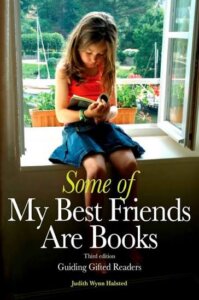 Permission to reprint this text was granted by the publisher, Gifted Unlimited, LLC. This is an excerpt of the book, Some of My Best Friends Are Books – Guiding Gifted Readers from Preschool to High School (3rd Edition). For the full book and more from Gifted Unlimited, visit Gifted Unlimited’s bookshop.
This article is provided as a service of the Davidson Institute for Talent Development, a 501(c)3 nonprofit dedicated to supporting profoundly gifted young people 18 and under. To learn more about the Davidson Institute’s programs, please visit www.DavidsonGifted.org.
Comments