The following excerpt is adapted from Searching for Meaning: Idealism, Bright Minds, Disillusionment, and Hope by James T. Webb, Ph.D., published by Gifted Unlimited, LLC. In this passage, Dr. Webb explores how bright, sensitive, and idealistic individuals may experience disillusionment and existential depression, and why these struggles can be so deeply tied to the search for meaning. The full book offers further insight into these experiences and thoughtful guidance for understanding them.
As bright, curious, and observant children grow up, they become aware that so many of the things that parents, teachers, and community leaders claim about the world are false, or at least highly colored. The result often is that they are disappointed, hurt, angry, disillusioned, and even depressed. Their idealism is badly damaged or even completely shattered, and their sense of their place in the world and how they matter may be in chaos. As one person said, “We live in a world built on promises, constructed by liars.” People who are brighter, more intelligent, and more sensitive—people we sometimes call gifted and talented—are more likely to experience this in a type of depression referred to as existential depression.
Being Bright and Disillusioned
Bright people tend to be more intense, sensitive, idealistic, and concerned with fairness, and they are quick to see inconsistencies and absurdities in the values and behaviors of others. They are able to see issues on a larger and more universal scale, along with the complexities and implications of those issues. Their sensitivity and idealism make them more likely to ask themselves difficult questions about the nature and purpose of their lives and the lives of those around them. Even at young ages, these children may ask, “If God created everything, why did He create mean people and allow evil into the world?” or “Why did my friend, who was a good person, die when he was only seven years old?” One colleague told me how he still remembers being kicked out of catechism classes because he asked too many challenging questions about the dogma.
These are not idle questions; these children focus on issues of fairness, wonder how they should live their lives, and want to know the rules of life and of the universe. “Who am I? is a question they may need to ask themselves all over again because the answers devised in childhood and adolescence were inaccurate or incomplete.”’
Quite early in life, bright children develop the capacity for metacognition—thinking about their thinking—often even before they develop the emotional and experiential tools to deal with it successfully.
Turning Disillusionment into Opportunities for Growth
Thinking about the meaning of life is not a new concept; it has existed for many centuries and is the basis for most religions and philosophies. Yet most of us do not ponder life meaning a regular basis. There are life situations, however, that can jerk us into having to examine our life and its meaning. Its what happens automatically when we experience a major loss, or the threat of a loss, and it highlights the transient nature of life, consequently prompting us to question the meaning of our lives and the value of our actions and behaviors. Perhaps a close relative dies, our home burns to the ground, we lose our job, a thief steals our prized heir looms, our marriage breaks up and ends in divorce accident and suffer serious injuries, or we develop a chronic disease. These kinds of experiences highlight the lack of control that have over so many aspects of our lives, and it causes our world to temporarily fall apart. It also may precipitate an episode in which we feel pessimistic. Others may try to reassure us with comments like “Everything happens for a reason,” or “God works in mysterious ways,” but these feel like illusions and seldom are satisfying. We question both our competence and our place in the world, and we may become disillusioned—with our friends, ourselves, and our life. In other words, we enter an existential depression. Most people, though, regain a sense of equilibrium within six months or so and resume their ordinary day-to-day living, which is filled with reassuring and comforting routines and achievements, and their depression lifts, though the existential cyst remains underneath.
Unfortunately, in my experience, individuals of higher intellectual ability are more likely than others to undergo a longer lasting recurrent existential depression, and it is not always triggered by precipitating events. Their disillusionments, existential questioning, and discomfort appear to arise spontaneously—just from observation and thinking, from their perception of life, or from their thoughts about the world, their place in it, and the meaning of their life. No matter the source, the information in this book will provide ideas and suggestions that you can use to help yourself and others when existential depression appears.
Most bright people have periods in their life when they experience disillusionment and ask themselves existential questions, but not every bright person experiences existential depression. When it does occur, however, it can be debilitating and can challenge an individual’s very survival. But existential questioning and depression also represent an opportunity—an opportunity to gain wisdom and turn the experience into a positive life lesson that can lead to personal growth. Although the opposite of disillusionment and existential depression may not be exuberant happiness, it can be contentment, acceptance, and sometimes a newfound feeling of belonging and purpose in which you run with life and make it your own.
Permission Statement
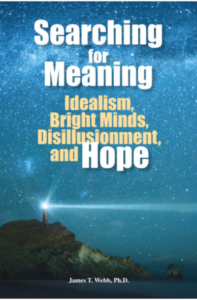 Permission to reprint this text was granted by the publisher, Gifted Unlimited, LLC. This is an excerpt from the book, Searching for Meaning: Idealism, Bright Minds, Disillusionment, and Hope by James T. Webb, Ph.D. Dr. Webb’s book goes much deeper into these themes and offers guidance for readers navigating similar questions about meaning, identity, and hope.
James T. Webb: In Memoriam
 The Davidson Institute remembers James Webb, PhD, whose work had a profound and lasting impact on our community. Dr. Webb founded Supporting Emotional Needs of the Gifted (SENG), helping create a place where families with 2e children could find support, understanding, and a sense of belonging. His legacy continues to live on through the many lives and conversations his work touched.
Comments