The following excerpt is adapted from Searching for Meaning: Idealism, Bright Minds, Disillusionment, and Hope by James T. Webb, Ph.D., published by Gifted Unlimited, LLC. In this passage, Dr. Webb explores how bright, sensitive, and idealistic individuals may experience disillusionment and existential depression, and why these struggles can be so deeply tied to the search for meaning. The full book offers further insight into these experiences and thoughtful guidance for understanding them.
“Since high school, I had a general direction that I lived by, certain rules that all I had to do was do them: go to school, classes, do what they tell you to do. I did that well; I functioned well within that environment. But it didn’t create much individuality or creativity within myself. I never really explored what I really wanted—what did I really want in life?”
School is often “the center of valedictorians’ activities and identities.” Perhaps, as Lisa Rivero suggests, “the time and focus necessary to be at the top of the class leaves little time for pondering questions of fulfillment or happiness…” These questions of life meaning seem to have been postponed for these bright minds until some years later, but then they came intensely.
Life Success and Life Meaning
So how does one define life success and life meaning? After all, as the Italian proverb says, “At the end of the game, the king and the pawn end up in the same box.”
The notion of success is an existential one; one person’s definition of success is not necessarily the same as another’s. Blogger Paul Buchheit described it this way: “Someone who spent his life working 80-hour weeks, living in hotels, and fighting his way up the corporate ladder to become VP of toilet paper marketing would probably consider himself more successful than the sandwich shop who spends his nights and weekends playing with his kids and working on hobby projects, but maybe the sandwich shop owner would be happier and healthier. Ultimately, it is up to each person to decide what success means to them, but I think it’s important that everyone he mindful of the decision they are making.”
Bright children and adults are particularly likely to struggle with questions like:
- What is the meaning of life?
- What is success?
- What is transient and unimportant versus what is truly important?
- How can I best survive and thrive in this sometimes-crazy world?
How should you live your life? The traditional route is not the only one that can lead to a meaningful life. Making a difference in the world, which is an idealistic notion held by many bright minds, means more than just educational or career achievements. Life success implies that you are doing something meaningful such that at the end of your life, you will feel that you have left the world a slightly better place.
At some point you become particularly aware of your own mortality; you only have a limited amount of time left on this earth. As the columnist Leonard Pitts said, “And life doesn’t just go. It also takes. Your knees, your hair, your waistline, your looks. Your loved ones, your friends, the career you used to have, the building where you used to work. You only have so much time to do what you want to do—to accomplish what you want to have accomplished by the end of your life. You may recognize that you have potential in many different areas, and this in itself can cause stress. You might say to yourself, “I chose to become a mathematics professor because I enjoy the challenge. But I also would like to explore so many other areas—for example. I’d like to he a naturalist, or a concert violinist, or a neurosurgeon, or work in international relations, or . . .” You clearly cannot be all that you could be. You have to make choices, unfair though that may seem.
You have likely become increasingly aware of many contradictions and absurdities around you and even within your own life. For example, you may value honesty, but you have realized that one can he too honest, and you find yourself telling “white lies” or not telling the whole truth. You become aware that ideals within your culture or family can clash or contradict and that everyday customs do not fit with logic or morality.
If you are to live your life in a meaningful and successful way but yet not be torn apart each day by angst and guilt, you probably will need to create some illusions. But then, if you allow yourself to think, you will experience at least as many disillusionments. Inquiring minds do want to know, but they want to inquire into matters that often involve a search for life meaning. This pursuit to understand yourself and where you fit in life and with others can result in existential depression, which is a type of depression that bright and idealistic people are particularly likely to experience. Existential depression is discussed in the next chapter, along with ways to cope with and manage it.
See also:
- Searching for Meaning: Giftedness, Disillusionment, and Depression
- Dabrowski’s Theory and Existential Depression in Gifted Children and Adults
- Existential depression in gifted individuals
Permission Statement
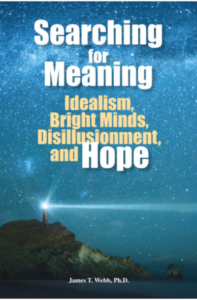 Permission to reprint this text was granted by the publisher, Gifted Unlimited, LLC. This is an excerpt from the book, Searching for Meaning: Idealism, Bright Minds, Disillusionment, and Hope by James T. Webb, Ph.D. Dr. Webb’s book goes much deeper into these themes and offers guidance for readers navigating similar questions about meaning, identity, and hope.
James T. Webb: In Memoriam
 The Davidson Institute remembers James Webb, PhD, whose work had a profound and lasting impact on our community. Dr. Webb founded Supporting Emotional Needs of the Gifted (SENG), helping create a place where families with 2e children could find support, understanding, and a sense of belonging. His legacy continues to live on through the many lives and conversations his work touched.
Comments